

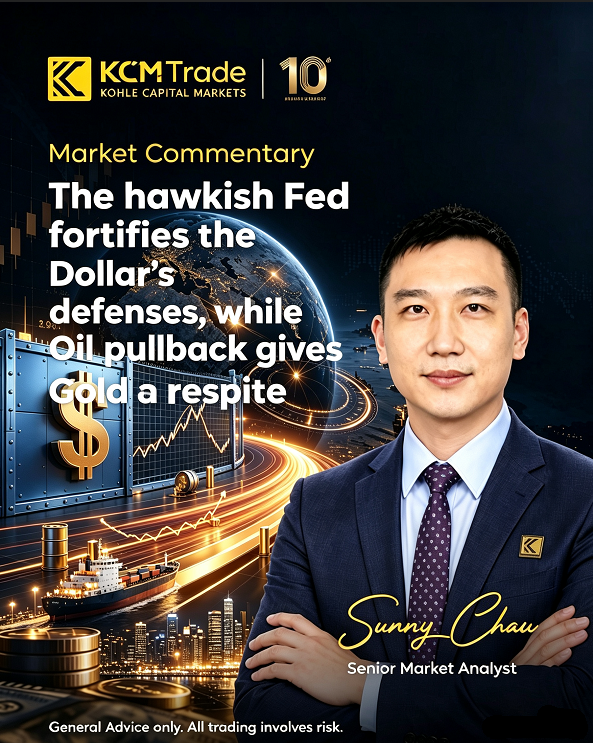
The hawkish Fed fortifies the Dollar’s defenses, while Oil pullback gives Gold a respite
Global markets last week were dominated by a “Super Central Bank Week.” On September 16, the Federal Reserve announced a 25-basis-point rate hike, raising the target range for the federal funds rate to 3.75%–4.00%, its first hike since July 2023, approved unanimously by a 12-0 vote. The dot plot showed that 16 of 18 officials expect at least one more hike this year, with four advocating two hikes. The Fed Chair Kevin Warsh reiterated a commitment to curbing inflation, significantly restoring market confidence in the Fed's policy stance.
The Bank of Japan announced on Friday a 25-basis-point hike to 1.25%, the highest since 1995, with a 7-2 vote; the two dissenting votes led traders to question the central bank's resolve regarding further hikes. The Bank of England kept rates unchanged at 3.75%, but warned that if the Middle East conflict continues to drive up inflation, further hikes may be needed. The divergence in policy paths among major global central banks was the core driver of the currency market last week.

Prior to the Fed's rate hike announcement last week, gold prices faced persistent pressure from a "triple threat": the 10-year US Treasury yield breaching 5%, a strengthening US dollar, and rising oil prices that fueled inflation expectations. Gold fell to a more-than-one-month low of approximately $4,235. However, following the announcement, short positions established in anticipation of the hike were rapidly covered. The pullback in oil prices eased inflation concerns and dampened the dollar's upward momentum, allowing gold to quickly reclaim the $4,300 mark and rebound toward previous highs. Additionally, Houthi forces launched their first missile attack on the Saudi capital, Riyadh; any further escalation in the Middle East could boost gold prices by stoking safe-haven demand, though such upward pressure typically manifests as short-lived, spike-like movements. In the medium to long term, oil prices remain the dominant driver; any further escalation of conflict could cause oil prices to surge again, triggering inflation and interest rate hike expectations that would weigh on the valuation of non-yielding assets like gold. Key resistance levels for gold are around $4,400–$4,450, while support levels between $4,330 and $4,280.
The US Dollar Index continued its upward trend last week, rising approximately 1.2% to close near 100.2—a seven-week high—with consecutive daily gains. The Federal Reserve rate hikes and a hawkish "dot plot" cleared the way for a stronger dollar; traders now estimate a greater than 55% probability of another rate hike in October, a significant increase from 27% just a week prior. Although the Bank of Japan raised rates to a 31-year high as expected, a 7-2 vote split revealed internal disagreement, and the lack of clear hawkish guidance caused the yen to depreciate rather than appreciate. The USD/JPY rose about 2% last week, trading between 153.38 and 158.05—marking the largest weekly gain since October 2025. Reports that Japanese authorities had conducted "rate checks"—a move seen as a preliminary step before market intervention—caused the dollar to pare some gains; the market remains highly alert to potential intervention by Japanese authorities to support the yen.

Looking ahead, the market's core tension lies in the fact that while the Fed's hawkish path supports the dollar, a pullback in oil prices has eased inflation concerns, offering gold some breathing room. However, with the dollar holding above the 100 mark and 10-year US Treasury yields remaining above 5%, a decisive trend-based breakout for gold prices appears unlikely in the short term; range-bound volatility is likely to persist. Regarding crude oil, the pace of pipeline restoration in Saudi Arabia is the critical variable: if operations resume as scheduled, Brent crude could further test support levels near $95. Regarding currencies, the US dollar shows a clear short-term upward trend; however, the easing of inflation concerns—driven by a retreat in oil prices—may somewhat limit its upside potential. The upcoming release of PCE inflation data next week will serve as the next critical juncture for the market to recalibrate its expectations regarding the interest rate hike path.

.jpg)

.jpg)
%20(1).jpg)
.jpg)
.jpg)
.jpg)