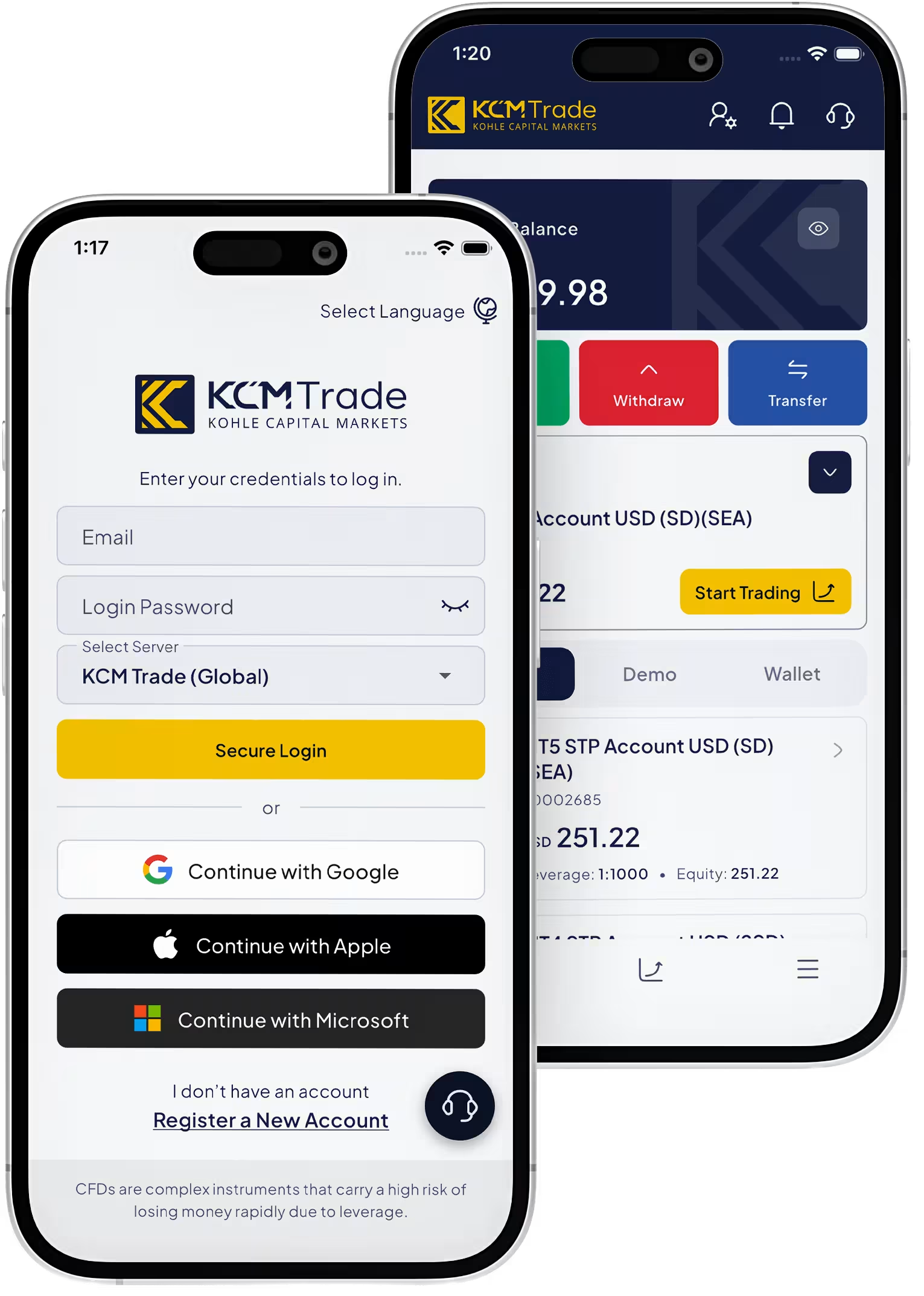
Scan for Android App



Scan for iOS App

Public Information and Risk Disclosure
Risk Disclosure
Risk Disclosure
Contracts for Difference (CFDs) are complex financial derivatives with no fixed settlement date; consequently, a CFD contract only expires when the client's position is closed.
As leveraged products, CFDs carry a high level of risk. They can result in significant losses for clients and are not suitable for everyone.
Clients should ensure that the risk they undertake does not exceed what they can afford to bear. Before making trading decisions, clients should ensure they fully understand the potential risks and their own level of experience. Clients should seek professional advice if necessary.
Product Description
A Contract for Difference (CFD) is a trading contract that reflects the performance of various assets, such as forex, precious metals, futures, and stocks. Profits from CFDs are derived from the difference between the buying price and the selling price.
Please note that forex and CFDs are traded on a margin basis; there is no need to actually own the underlying stocks or index futures, nor does physical delivery of the underlying assets take place. For example, when a client purchases a stock CFD, they are essentially speculating on the rise or fall of the stock's value.
Key risks of trading CFDs
- Forex and Contracts for Difference (CFDs) are complex financial products that may not be suitable for all types of clients. Before considering trading these products, clients should ensure they understand the nature and risks of the products and assess whether market movements align with their expectations. Clients should also ensure they have the financial capacity to bear any associated losses.
- Forex and CFDs are leveraged products that can amplify potential profits or losses. Clients must be aware that if the market moves against their position, margin levels will decline, and the risk of potential loss will increase. As the value of Forex and CFDs is influenced by market volatility, clients need to constantly monitor market changes.
- Trading Forex and CFDs may not be suitable for everyone. Clients should seek qualified, independent financial advice if necessary and manage risks prudently. Before trading, clients must weigh risks against potential returns and understand risk management strategies.
KCM Trade does not recommend immediate trading unless one of the following conditions is met:
- The client intends to engage in speculation or hedge an existing portfolio over a very short timeframe;
- The client possesses extensive trading experience and can withstand losses incurred in highly volatile markets.
Before trading Forex and CFDs, clients must understand that these products are not suitable for "long-term holding." Clients need to continuously monitor price movements over short timeframes (minutes, hours, or days). Holding positions overnight can also entail significant risks and additional costs. Sharp fluctuations in securities and other financial markets, as well as adjustments to leverage ratios, can lead to drastic changes in a client's overall position. Clients may be immediately required to deposit additional margin or take other actions to manage their risk exposure. Therefore, KCM Trade recommends trading Forex and CFDs only if the client has sufficient time and the ability to regularly monitor market movements.
Additional risks associated with trading large-volume orders
In Forex or CFD trading—particularly during periods of high market volatility—large-volume orders often encounter price discrepancies, which can introduce additional risk. Trades exceeding 4 lots are more likely to experience significant price variances due to the phenomenon of liquidity price tiering.
Liquidity price tiering refers to the distribution of trading volume and availability within the market. When market liquidity is low, this tiering effect becomes more pronounced, potentially leading to more significant price discrepancies for large-volume orders. To ensure execution speed, KCM Trade prioritizes execution over price. For orders of 4 lots or more, the substantial volume may require the order to be filled at deeper levels of market liquidity, resulting in a significant difference between the actual execution price and the client's expected price.
Therefore, when trading Forex or CFDs, clients should be mindful of order sizes and avoid placing excessively large orders in a single transaction to minimize trading risk.
Notice Regarding Additional Risks Associated with Cross-Currency Pairs
"Cross rates" (or "crosses") refer to currency pairs that do not involve the US dollar—such as EUR/GBP, AUD/JPY, or GBP/NZD. While the terms "direct pairs" (or "majors") and "cross rates" are common conventions in the forex market, they are not formal technical designations. If you have any questions regarding cross-rate trading, please feel free to consult the online customer service representative via the chat widget in the bottom-right corner.
Investors should pay special attention to the following risks associated with cross-rate trading:
- Lack of clear patterns
Even when using established technical analysis methods, predicting cross-rate movements with high accuracy is difficult. Consequently, assessing the trend of a cross rate often relies heavily on analyzing how each of the two constituent currencies performs against the US dollar. - Higher risk compared to direct pairs
As mentioned above, cross rates typically exhibit greater volatility than direct pairs. For instance, significant fluctuations in the US dollar can expose cross-rate trades to substantial risk. - Spreads prone to extreme widening
Since the currencies involved in cross rates often represent smaller economies, spreads can widen dramatically—particularly during local holidays or periods of fluctuating liquidity at market open or close. Such volatility can lead to forced liquidation (or "blowing out" the account) due to insufficient net equity, even if the position is hedged.
Learn More – Other Characteristics of Cross-Rate Trading:
- Higher volatility than direct pairs
For example, in 2013, the EUR/AUD pair rose by over 3,000 points at its peak, whereas the EUR/USD pair rose by only about 800 points during the same period. The return potential for the EUR/AUD cross rate was more than four times that of the direct pair, highlighting the significant potential inherent in cross-rate trading. - A common strategy for unwinding trapped positions
Cross-rate trading is frequently used to manage "trapped" positions (trades currently in a loss). If an investor is unwilling to close a losing direct-pair trade (take a loss), they might choose to open a cross-rate position in the opposite direction as a strategy to potentially offset the loss and unwind the position.
Risk of failure in setting stop-loss limits
KCM Trade’s trading platform offers a "Stop Loss" order function, enabling clients to set loss limits and close positions promptly to manage risk.
However, please note that this function does not guarantee that the position will be closed at the exact price specified.
In the event of abnormal market volatility affecting Forex and CFD assets, clients may incur losses exceeding their expectations.
Therefore, when using Stop Loss orders, clients should fully understand and assess market risks, formulate stop-loss strategies prudently, and adjust or update their risk control measures in a timely manner based on changing market conditions.
Anti-money laundering risk
Clients must provide accurate and complete information when opening an account. Failure to do so may result in the account being frozen in accordance with the Financial Act 2001, pending a regulatory review of the client's funds.
KCM Trade strictly prohibits and penalizes any money laundering activities involving securities or financial derivatives trading. Should any deposit or withdrawal activity raise suspicions of money laundering, the Company will immediately report the matter to regulatory authorities and may charge the client an administrative compliance fee of up to 10% of the funds in the client's account.
To ensure the security of client funds, KCM Trade accepts deposits only from accounts held in the client's own name and does not permit deposits or withdrawals via third-party accounts. Clients are advised that the Company assumes no liability for financial losses arising from the use of accounts not held in their own name.
Risk of forced account liquidation
- 设置止损线,以避免因一笔交易产生过大亏损而导致其他开仓的保证金不足;
- 避免在重要事件公布期间进行交易,例如美国非农数据公布日等;
- 预留足够的资金在账户中,并避免开仓过多;
- 时刻留意市场变化,特别是在行情波动较大的时候。
To avoid forced liquidation, KCM Trade strongly recommends managing your positions prudently and maintaining a margin level of at least 1000% at all times. Please note that if the margin level falls below 50%, forced liquidation will be triggered, resulting in the closure of all open positions. To reduce the risk of forced liquidation, KCM Trade suggests the following measures:
- Set stop-loss orders to prevent a single trade from incurring excessive losses that could deplete the margin available for other open positions;
- Avoid trading during the release of major economic data or significant events, such as the US Non-Farm Payrolls (NFP) announcement;
- Maintain sufficient funds in your account and avoid opening an excessive number of positions;
- Monitor market developments closely, especially during periods of high volatility.
Please note that while these measures cannot guarantee protection against losses, they can help reduce the likelihood of forced liquidation.
Regulations regarding accounts inactive for more than 180 days (dormant accounts)
A trading account will be classified as "dormant" and rendered unable to execute any trades if it has not logged into the client system for more than 180 consecutive days and the total account balance is less than the equivalent of USD 10,000. For joint accounts, the balances of all associated joint accounts will be aggregated for this calculation. To reactivate trading capabilities, clients must complete an instruction form and submit the necessary documentation (specific requirements vary by region) via email to the customer service address: cs@kcmtrade.com. Please note that KCM Trade will suspend the provision of monthly account statements once an account is classified as dormant.