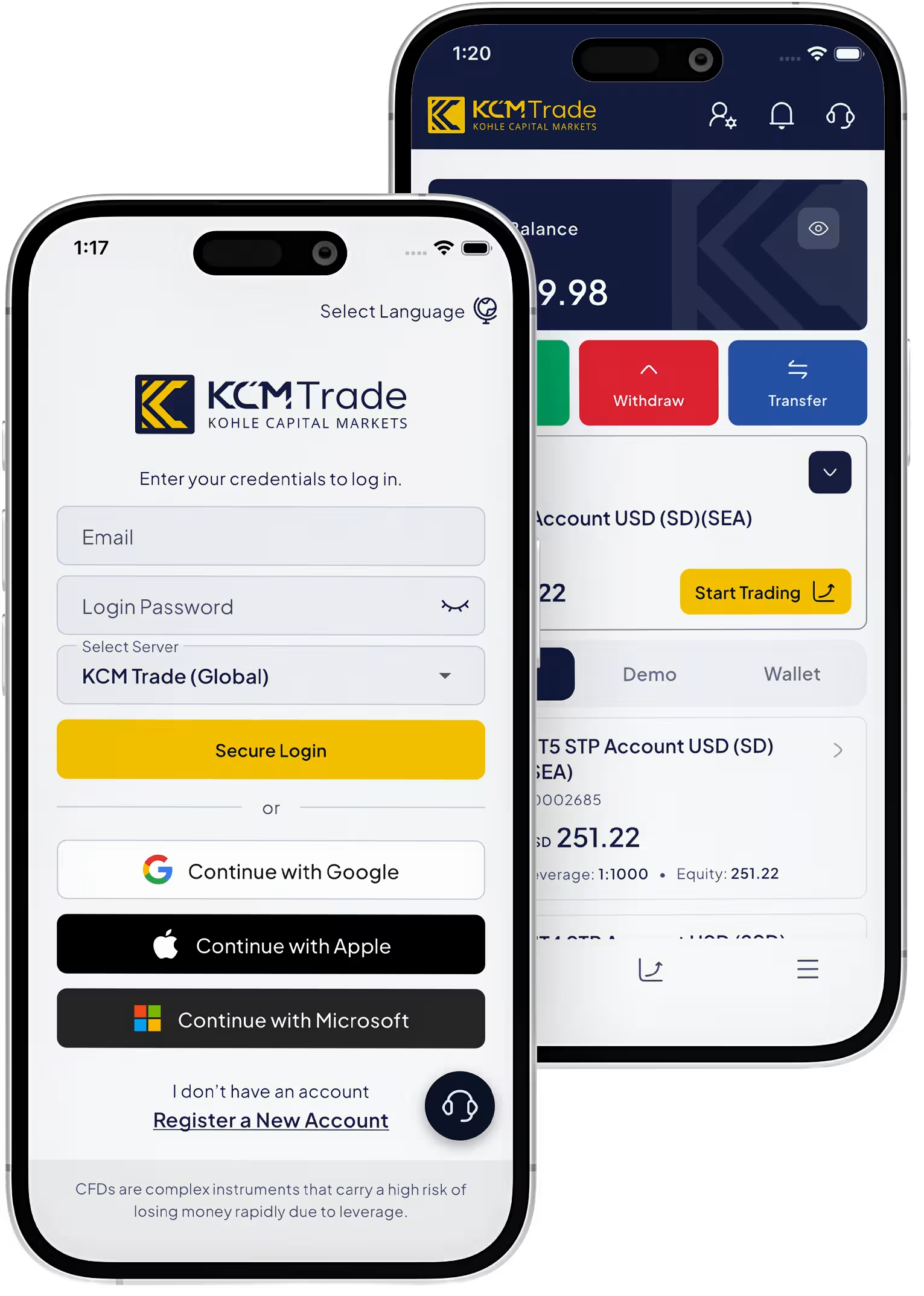




Balance, equity, and free margin are three of the most fundamental figures on a forex trading account, and understanding how they differ — and how they interact — is essential for managing risk.
Balance is the financial outcome of all your completed transactions, including deposits, withdrawals, and closed trades. It does not move while a trade is still open. Equity reflects your balance adjusted for the profit or loss of any currently open trades — in other words, it's the amount you would have left if you closed every open position right now. Free margin is the portion of your equity that is not tied up as margin on open positions; it's the money available either to withdraw or to open new trades.
The relationship between the three is straightforward: equity moves away from balance as soon as a trade is opened and its floating profit or loss changes, and free margin is simply what's left of that equity once the margin required for open positions has been set aside.
Key Takeaways
- Balance = the result of all closed transactions (deposits, withdrawals, and closed trades). It stays fixed while trades are open.
- Equity = Balance + Floating Profit + Swaps, or Balance − Floating Loss + Swaps. It also equals Margin + Free Margin.
- Free Margin = Equity − Margin. It's the money available for new trades or withdrawal.
- Balance only changes when a trade is closed or when you deposit/withdraw funds.
- Equity and free margin move in real time as the floating profit or loss on open trades changes.
- A negative balance is possible if a closed loss exceeds the balance while other trades remain open with profit.
- Maintaining sufficient free margin helps traders avoid margin calls and stop-outs.
What Is Balance in Forex Trading?
Definition of Balance
Balance is the financial outcome of all completed transactions on a trading account, including deposits, withdrawals, and closed trades. It reflects only what has already been settled — it does not account for any trade that is still open.
How Balance Is Calculated
Balance is built up from your starting deposit, adjusted for any further deposits or withdrawals, plus or minus the realized profit or loss from each trade once it is closed. Because it only updates on closed transactions, balance remains unchanged for as long as a position stays open.
Example of Balance in a Forex Trading Account
Suppose you open a trading account and deposit USD 500 — this is your starting balance. You then trade and close two orders: one with a profit of USD 100 and one with a loss of USD 50.
Your balance = 500 + 100 − 50 = USD 550.
Can Forex Account Balance Become Negative?
Yes. A negative balance is possible if you close an order where the loss is greater than your balance, while other orders remain open with a profit. In that scenario, the closed loss is deducted immediately, which can push the balance below zero even though the remaining open trades may later recover the shortfall.
What Is Equity in Forex Trading?
Definition of Equity
Equity is a figure that denotes the combined result (profit or loss) of all open orders. It reflects the amount of funds that would remain in the account if the trader closed all open orders at that moment.
Equity vs. Balance
The key distinction is timing: balance reflects only closed trades, while equity reflects your balance plus the real-time floating result of any trades still open. As long as a trade remains open, balance stays fixed even as equity rises or falls with the market.
Equity Calculation Formula
Equity can be expressed in a few equivalent ways:
- Equity = Balance + Floating Profit + Swaps
- Equity = Balance − Floating Loss + Swaps
- Equity = Margin + Free Margin
Example of Equity With Floating Profit
You open a trading account and deposit USD 500 — your starting balance. Before you begin trading, equity equals balance. You then open a trade that shows a floating profit of USD 100, with no swap charges at the moment.
Your equity = 500 + 100 = USD 600.
Notably, your balance remains USD 500 for as long as that trade stays open — only equity reflects the unrealized gain.
What Is Free Margin in Forex Trading?
Definition of Free Margin
Free margin is the amount of funds that has not been committed as margin for open positions. It is the portion of your account that can be withdrawn or used to open new trades.
Free Margin Calculation Formula
Free Margin = Equity − Margin
Example of Free Margin Calculation
You have a trading account with USD 1000. You open a few positions that require USD 200 in margin, and the total floating profit on those positions is USD 300.
- Balance = USD 1000
- Equity = 1000 + 300 = USD 1300
- Free Margin = Equity − Margin = 1300 − 200 = USD 1100
Why Free Margin Matters for Forex Risk Management
Free margin represents your cushion for absorbing further floating losses or opening additional positions. A good risk management practice is to always maintain sufficient free margin, since running it down too far increases the risk of a margin call or stop-out.
How Are Balance, Equity, and Free Margin Related?
Relationship Between Balance, Equity, and Margin
Equity is derived directly from balance, adjusted for the floating profit or loss on open trades and any swaps. Equity in turn splits into two parts: the margin being used to hold open positions, and the free margin left over (Equity = Margin + Free Margin). So a change in an open trade's floating P&L flows through to equity first, and then to free margin — balance is the only one of the three that doesn't move until the trade is actually closed.
Example of How the Three Metrics Change During a Trade
Using the free margin example above: before opening any trades, balance, equity, and free margin on the USD 1000 account are all equal at USD 1000. Once positions are opened requiring USD 200 in margin and generating USD 300 in floating profit, balance stays at USD 1000 (unchanged, since nothing has closed), equity rises to USD 1300 (balance plus floating profit), and free margin becomes USD 1100 (equity minus the margin in use). This shows how equity and free margin respond immediately to open-trade performance while balance lags behind until the trade closes.
Balance vs. Equity vs. Free Margin: Key Differences
Balance
The settled value of the account — deposits, withdrawals, and closed-trade results only. Unaffected by open positions.
Equity
Balance adjusted in real time for the floating profit or loss (and swaps) of open positions. Equals what you'd have if you closed everything right now.
Free Margin
The unused portion of equity — what's left after subtracting the margin tied up in open positions. Available for new trades or withdrawal.
How to Use Balance, Equity, and Free Margin in Forex Trading?
Monitoring Open Positions and Floating P&L
Since equity reflects the real-time result of open orders, watching equity (rather than balance alone) gives a trader a live read on how their open positions are performing.
Assessing Available Funds for New Positions
Free margin tells a trader how much capital is actually available to open additional trades or to withdraw, since it already accounts for what's committed to existing positions.
Avoiding Margin Calls and Stop-Outs
Tracking free margin helps a trader see how much buffer remains before floating losses erode the account to the point of triggering a margin call or stop-out.
Risks and Limitations of Relying on Account Margin Metrics
Impact of Floating Losses on Equity and Free Margin
Because equity equals balance minus any floating loss (plus swaps), a losing open position reduces equity immediately — and since free margin is equity minus margin, free margin shrinks right along with it, even though balance itself hasn't changed yet.
Margin Call and Stop-Out Risk
As free margin is drawn down by floating losses, the account moves closer to a margin call or stop-out. This is the practical reason free margin needs active monitoring rather than being checked only occasionally.
Why Sufficient Free Margin Is Important
Keeping free margin comfortably above zero gives a trade room to move against you without forcing a forced closure of positions. Running free margin too low leaves little room for normal market fluctuation before a margin call or stop-out is triggered.
FAQs
What Is the Difference Between Balance and Equity in Forex?
Balance is the result of your closed transactions only, so it stays fixed while a trade is open. Equity is your balance adjusted for the floating profit or loss of open trades, so it changes in real time as the market moves.
What Is the Difference Between Equity and Free Margin?
Equity is the total value of the account if all open trades were closed right now (Margin + Free Margin). Free margin is only the unused portion of that equity — what remains after the margin required for open positions is set aside.
Can Free Margin Be Negative in Forex Trading?
Based on the formula Free Margin = Equity − Margin, free margin would fall toward zero as floating losses reduce equity while margin requirements stay the same. This is the situation that leads to margin calls and stop-outs. The source material doesn't detail the exact mechanics of a negative free margin scenario, so treat this as a general implication of the formula rather than a fully specified rule.
Why Does Equity Change While Balance Stays the Same?
Equity incorporates the floating (unrealized) profit or loss of open trades, while balance only reflects transactions that have already been completed. Until a trade is closed, its profit or loss shows up in equity but not in balance.
How Much Free Margin Should a Forex Trader Maintain?
The source material advises maintaining "sufficient" free margin as good risk management practice to avoid margin calls and stop-outs, but doesn't specify an exact amount or percentage. See Content Gap Notes below.
Conclusion
Balance, equity, and free margin each capture a different slice of a trading account's financial picture: balance reflects what's settled, equity reflects that balance adjusted for live open-trade performance, and free margin shows what's actually available to use. Because equity and free margin respond immediately to floating profit and loss while balance does not, keeping an eye on all three — rather than balance alone — is central to managing risk and avoiding margin calls or stop-outs.